
Maintenance
A Realistic Garage Door Maintenance Schedule
Most garage door maintenance advice online is padded out with tasks that achieve nothing. Here is the version from people who repair these for a living, including the parts that are honestly not worth your time.
Twice a year: lubricate the moving parts
This is the one that actually matters, and it is fifteen minutes. Use a garage-door-specific lubricant — a silicone or lithium spray. Not WD-40, which is a solvent and cleans rather than lubricates, and not grease, which collects grit.
- Rollers. A light spray on the stems and bearings of each roller, not the wheel face.
- Hinges. Every pivot point between sections.
- Bearing plates. The bearings at each end of the torsion shaft, and the centre one if fitted.
- Springs. A light mist along the coil. It reduces friction between coils and slows corrosion, which matters in Florida humidity.
- Opener rail. A thin film on a chain drive. Belt drives need nothing.
- Lock and latch. If fitted.
Twice a year: the balance test
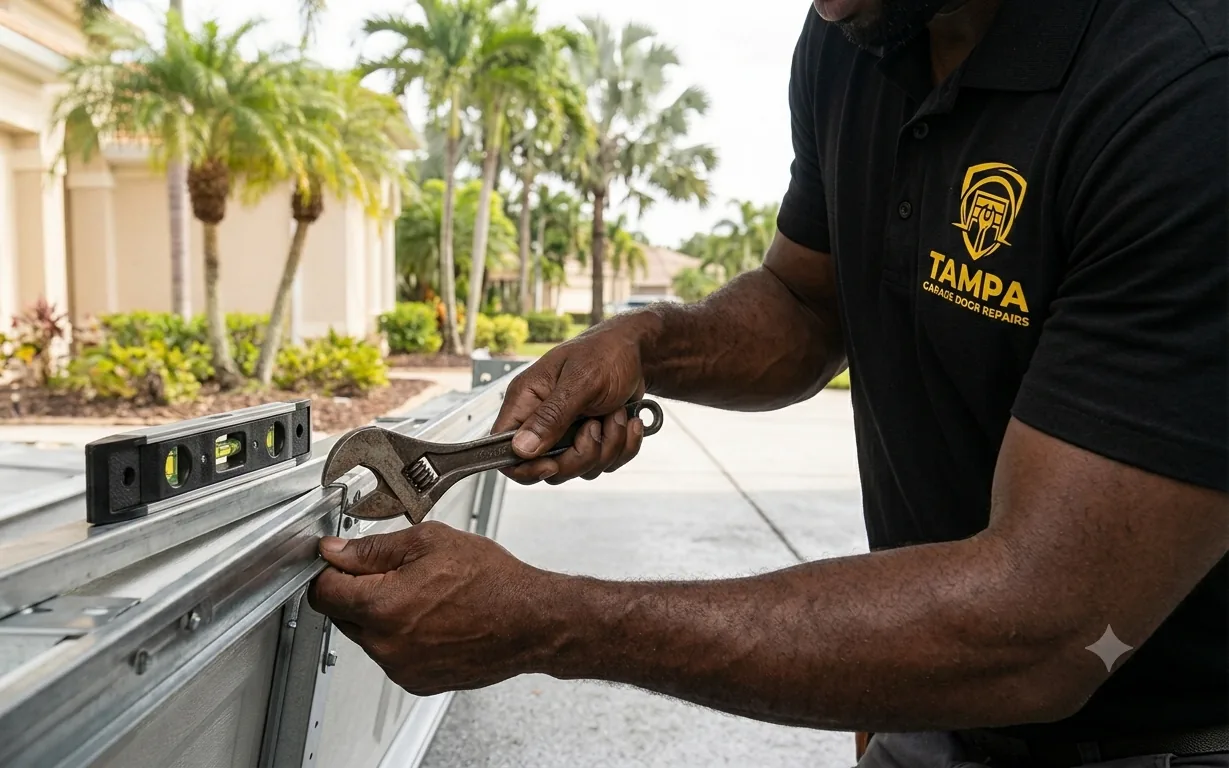
The most informative check available to you, and it predicts spring failure before it happens. With the door fully closed, pull the red release cord to disconnect the opener, then lift the door manually to about waist height and let go carefully.
A properly balanced door stays roughly where you left it. If it slams down or shoots up, the spring tension is wrong. If it fights you hard on the way up, the springs are weakening. Any of those is worth a call before the spring actually breaks and strands your car. Re-engage the trolley before using the opener again.
Twice a year: the safety reverse test
Federally required equipment, so worth confirming it works. Lay a length of two-by-four flat on the floor in the door’s path and close the door. On contact it should reverse immediately. Then wave a broom handle through the photo-eye beam while closing — it should reverse without contact.
If either test fails, stop using the opener until it is sorted. This is the system that protects a child or pet who walks under the door at the wrong moment.
Annually: look and listen
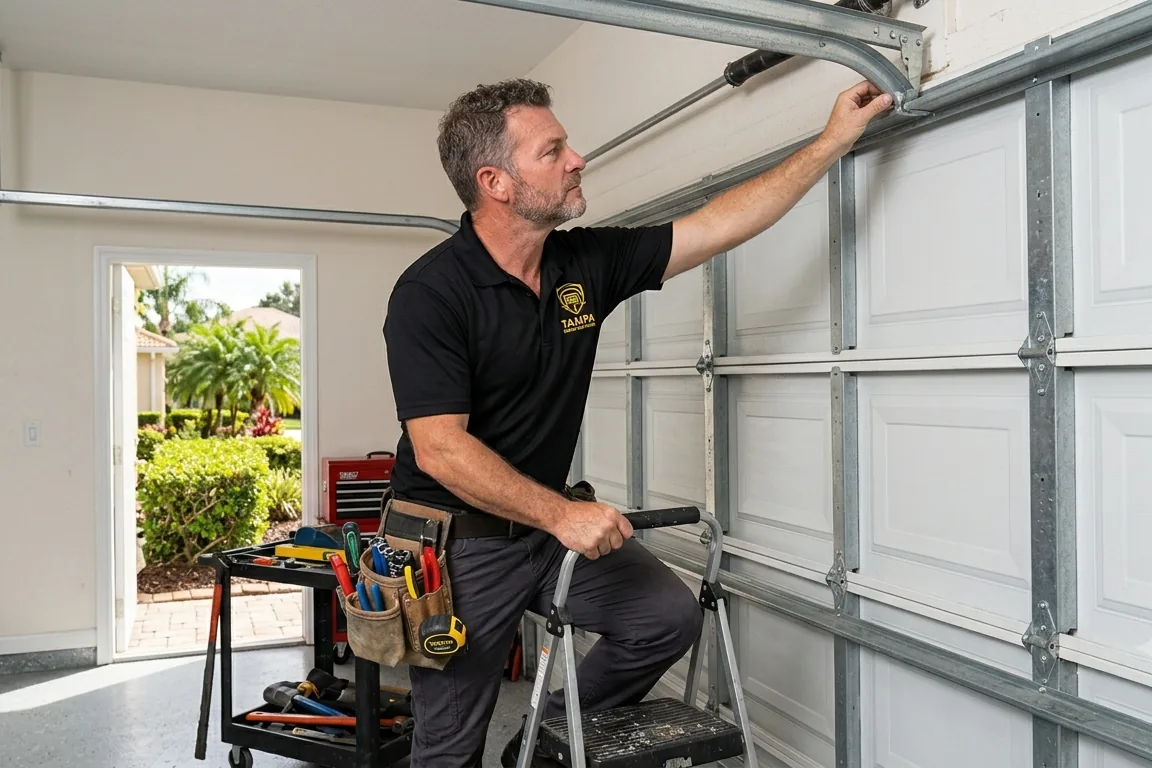
- Cables. Check the bottom corners for fraying or broken strands. Do not touch them, just look. Frayed means call.
- Rollers. Worn or cracked nylon, or wobble in the stem. Brittle nylon is common in hot Tampa garages.
- Hardware tightness. Hinge and bracket bolts work loose from vibration. Snug them, do not overtighten.
- Weather seal. The rubber strip along the bottom. Cracked or flattened seal lets water and pests in.
- Listen through a full cycle. New noises are the earliest warning you get, and they are cheap to act on.
What is not worth doing
- Touching the springs or cables. Beyond a light lubricant mist, these are under enormous tension. Look, do not adjust.
- Adjusting the spring tension. Winding bars and training. Not a homeowner job under any circumstances.
- Painting the door for protection. Purely cosmetic. Factory finishes are already coated.
- Replacing rollers on a schedule. Replace them when they are worn or noisy, not by calendar.
- Buying an annual service contract. Inland, the twice-yearly lubrication above achieves most of it yourself. Genuinely worth it on the water, where salt makes professional servicing pay for itself.
A realistic year
| Item | Figure | Notes |
|---|---|---|
| Spring | Lubricate moving parts | 15 min |
| Spring | Balance test | 2 min |
| Spring | Safety reverse test | 3 min |
| Spring | Visual check of cables and rollers | 5 min |
| Autumn | Repeat lubrication and both tests | 20 min |
| Before storm season | Know the release cord, check springs | 5 min |
Call it fifty minutes a year. It will not make a door last forever — springs die of cycles and nothing changes that. What it does is keep rollers and hinges from grinding themselves out early, catch a fraying cable before it snaps, and give you warning that the springs are going while your car is still able to leave the garage.
What to do if you hear something new
Act on it. Nearly every expensive repair we attend was preceded by weeks or months of a noise the homeowner had got used to. Grinding is usually rollers, which is a $120 to $230 fix that becomes a track replacement if ignored. A bang followed by nothing is a spring. A door that has started moving unevenly is usually a cable.
Questions
Related questions
A garage-door-specific silicone or white lithium spray. Not WD-40, which is a solvent that cleans rather than lubricates, and not grease, which collects grit. A single can covers several years of twice-yearly servicing.
No — this is the most common well-meaning mistake. The track is a guide, not a bearing surface, and lubricant there traps grit into an abrasive paste that wears rollers faster. Wipe the tracks clean with a dry cloth instead.
With the door closed, pull the release cord, lift the door to waist height and let go carefully. A balanced door stays put. If it slams down or springs up, tension is wrong. If it fights you on the way up, the springs are weakening.
Twice a year alongside the lubrication. Lay a two-by-four flat in the door path — the door should reverse on contact. Then break the photo-eye beam while closing; it should reverse without contact. Stop using the opener if either fails.
Inland, generally not — the twice-yearly routine above is most of what a service visit does and you can do it yourself. On the water in Apollo Beach or South Tampa it genuinely is worth it, because salt corrosion needs monitoring you cannot easily do.
It delays it modestly and, more usefully, warns you it is coming. Springs fail from accumulated cycles and nothing changes that arithmetic. Lubrication reduces friction and the balance test tells you they are weakening while your car can still get out.
Not urgent, but do not ignore it. Noise means something is wearing, usually rollers, hinges or bearings, and it is cheap at that stage. A seized roller starts damaging the track, and track work costs several times what rollers do.
Hinge and bracket bolts, yes — they work loose from vibration and snugging them takes minutes. Do not overtighten and do not touch anything attached to the springs or cables. If a bolt hole is stripped, that needs a proper repair.
Keep reading
More garage door guides
Get your door working today
Same-day service on most repairs, a flat price before we start, and no charge for the diagnosis. Tell us what the door is doing and we will tell you what it costs.
Mon–Sat 7:00am–8:00pm · Licensed & insured · Serving Tampa, Brandon, Riverview & Wesley Chapel