
Diagnosis
Garage Door Won’t Close? Start With the Sensors
This is the guide that costs us the most money, and it is the one we get thanked for most. If your garage door starts to close and then runs straight back up — usually with the opener light blinking — there is a strong chance you can fix it yourself in five minutes for nothing.
What is actually happening
Since 1993, every residential garage door opener sold in the US has been required to have photo-eye safety sensors. Two small units sit on either side of the opening, four to six inches off the floor, pointing at each other. One sends an invisible infrared beam, the other receives it. If anything interrupts that beam while the door is closing, the opener immediately reverses.
That system exists because garage doors killed children before it. So when it errs, it errs toward stopping the door, and it treats a dirty lens or a slightly knocked bracket exactly the same as a child in the doorway. Which is the correct behaviour, and also why a five-cent film of dust produces what feels like a broken door.
The five-minute checklist
- Find both sensors. Small plastic units mounted low on each side of the opening, usually clipped to the vertical track.
- Wipe both lenses. A soft dry cloth. Tampa garages accumulate dust, pollen and spider webs, and a hazy lens is genuinely enough to break the beam.
- Clear the beam path. Look along the invisible line between them. A recycling bin, a bike wheel, a coiled hose, a stray palm frond blown in.
- Check the indicator LEDs. Both sensors have a small light. Both should be lit and steady. A blinking LED almost always means misalignment. A dark LED means no power or a wiring fault.
- Nudge one gently into line. If one is blinking, loosen its bracket slightly and adjust until the light goes solid, then tighten. Sensors get knocked by cars, bikes and bins constantly.
- Cycle the door. If it closes normally, you are finished and you owe nobody anything.
When it is not just alignment
Call someone if you have worked through the list and any of the following is true.
- An LED stays dark. Suggests a wiring break, a failed sensor, or a terminal problem at the opener head.
- The wiring looks damaged. Rodents get into garages and the sensor wire is thin. Chewed insulation is a common find.
- It only fails in the afternoon. Direct low sun into the receiving eye can swamp the beam. Real, and more common on west-facing garages than people expect.
- The terminals look corroded. Near the coast, salt reaches the contacts at the opener head.
- The door reverses at the floor rather than partway. Different fault entirely — that is close-force or travel-limit settings, not sensors.
The distinction that saves a wasted call
Where the door reverses tells you which problem you have, and it is worth being precise about it when you describe it on the phone.
| Item | Figure | Notes |
|---|---|---|
| Reverses partway down | Safety sensors | Free – $145 |
| Reverses on touching the floor | Close-force / travel limits | Free – $95 |
| Will not start closing at all | Sensors, lock mode or logic board | $0 – $340 |
| Closes then immediately reopens | Travel limit set too low | Free – $95 |
| Only fails in the afternoon | Sun glare on the sensor | $0 – $145 |
| No response from anything | Power, board or wall control | $95 – $340 |
Do not bypass them
You can find instructions online for defeating garage door sensors. Please do not, and we will not do it for you either. It is the one request we refuse outright regardless of how the customer frames it.
A garage door closes with enough force to injure a child or a pet who walks under it at the wrong moment, and the photo-eye system is the only thing watching for that. Replacing a failed sensor pair is $115 to $195. There is no version of this where saving that money is the right call.
The lock button catches people out
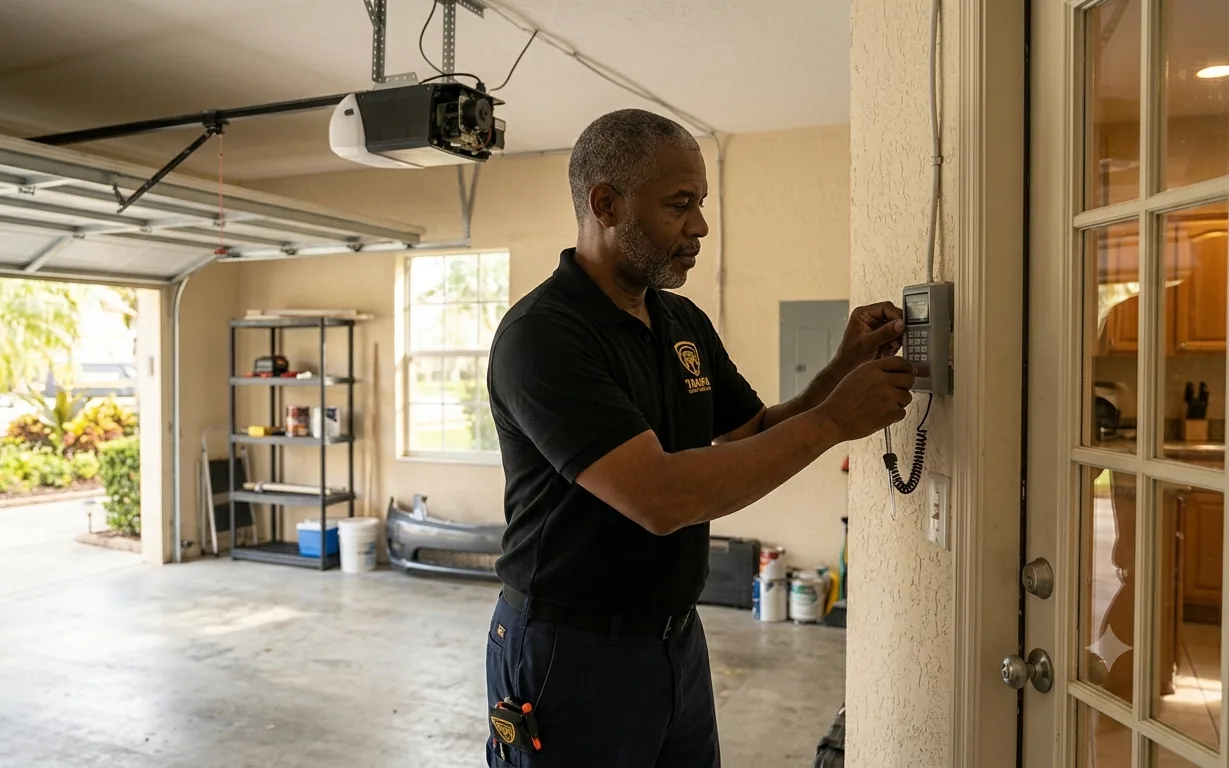
Worth checking before anything else: most wall control panels have a lock or vacation button. When engaged, it disables the remotes entirely and the door will not respond to them, though the wall button still works. Someone leans on the panel, the light on it starts blinking, and the door appears broken. Pressing and holding it for a few seconds clears it, at no cost.
If you do need us
A sensor pair is $115 to $195 fitted and aligned. Wiring repair runs $95 to $185. Realignment on its own is often free if we are already there for something else. It is one of the cheapest visits we make, and the diagnosis costs nothing either way. Full detail on sensor and remote repair.
Questions
Related questions
Almost always the safety sensors. Wipe both lenses, clear anything in the beam path, and check both LEDs are steady rather than blinking. That fixes it at no cost in the large majority of cases.
A blinking sensor LED means misalignment — the two units are not seeing each other properly. A blinking light on the opener head is usually a diagnostic code, and most manuals list what each pattern means. Both point at the sensor circuit rather than the motor.
A pair is $115 to $195 installed and aligned. Wiring repair, if a run has been chewed or damaged, is $95 to $185. Realignment alone is often free when we are on site for something else.
Yes. That is the close-force or travel-limit setting — the opener thinks it has hit an obstruction when it reaches the ground. It is an adjustment rather than a part, and often free alongside another repair.
No, and we will not do it either. They are federally required and they exist because garage doors killed children before them. A failed pair is $115 to $195 to replace, which is not a corner worth cutting.
Direct low sun shining into the receiving sensor can overwhelm the infrared beam. It is more common on west-facing garages than most people realise. Repositioning the sensors or fitting small shields solves it without new parts.
Check the lock or vacation button on the wall panel first — when engaged it disables remotes entirely and the panel light usually blinks. Holding it for a few seconds clears it. If not, try fresh batteries and re-pairing.
Only if the free steps have not worked. We will always walk you through the checklist on the phone first, and a good number of callers never need a visit. If the LEDs stay dark or the wiring is damaged, then yes.
Keep reading
More garage door guides
Get your door working today
Same-day service on most repairs, a flat price before we start, and no charge for the diagnosis. Tell us what the door is doing and we will tell you what it costs.
Mon–Sat 7:00am–8:00pm · Licensed & insured · Serving Tampa, Brandon, Riverview & Wesley Chapel